
A solar water pump inverter and a standard VFD for pump applications often share the same kind of housing, terminals and keypad, and from the outside little separates them. Both convert power to a variable frequency, and both turn a pump motor at adjustable speed.
The differences sit in the firmware and in the input stage, and they decide whether a drive can run a pump from sunlight alone or only from a stable grid. The supply each one was designed for is the reference point for any fair comparison.
Assumptions Built Into a Standard Pump Drive
A conventional VFD for pump service expects a stiff AC supply whose voltage and frequency change very little. Its control goals are process goals: hold a pressure with PID, follow a flow setpoint, sleep when demand stops.
If supply voltage sags, the drive treats the sag as a disturbance to ride through or as a fault, and it has no reason to reduce speed in step with available energy, because the grid is assumed to supply whatever the pump requires.
That assumption shapes the hardware too. The input rectifier is sized for the grid’s voltage range, and there is usually no provision for a high-voltage DC source such as a string of solar panels. Water-management functions are normally absent as well, because on a mains-fed system a pressure transducer and a separate controller take care of those tasks.
What Changes With a Photovoltaic Source
An array behaves very differently from the grid. Its power varies through the day, its voltage depends on the operating point, and drawing too much current collapses the voltage instead of merely raising losses.
A solar water pump inverter therefore treats available power as the controlling limit: it searches for the array’s maximum power point and sets pump speed to whatever that power can sustain. A pump that kept demanding full speed as clouds passed would drag the array away from its maximum power point and stall.
The input stage must also accept a wide DC voltage range, from the low voltage of a weak morning array to the open-circuit voltage of a cold, bright day. Where grid or generator power exists as well, a hybrid VFD combines both inputs, so the pump can keep running when sunlight is insufficient. Low-light starting belongs to the same logic, since the drive waits until the array can turn the pump at a useful speed, avoiding repeated starts at dawn.
Comparing the Pump Functions
Several functions separate the two drive types more sharply than any hardware specification. Dormancy and automatic wake-up follow sunlight instead of a timer or pressure switch, dry-run protection stops the pump when the source runs low, tank-level control stops it when storage is full, and recording of energy and water volume takes the place of a separate flow meter and data logger. A VFD for pump use on the grid can be programmed to approximate some of these, though seldom all of them.
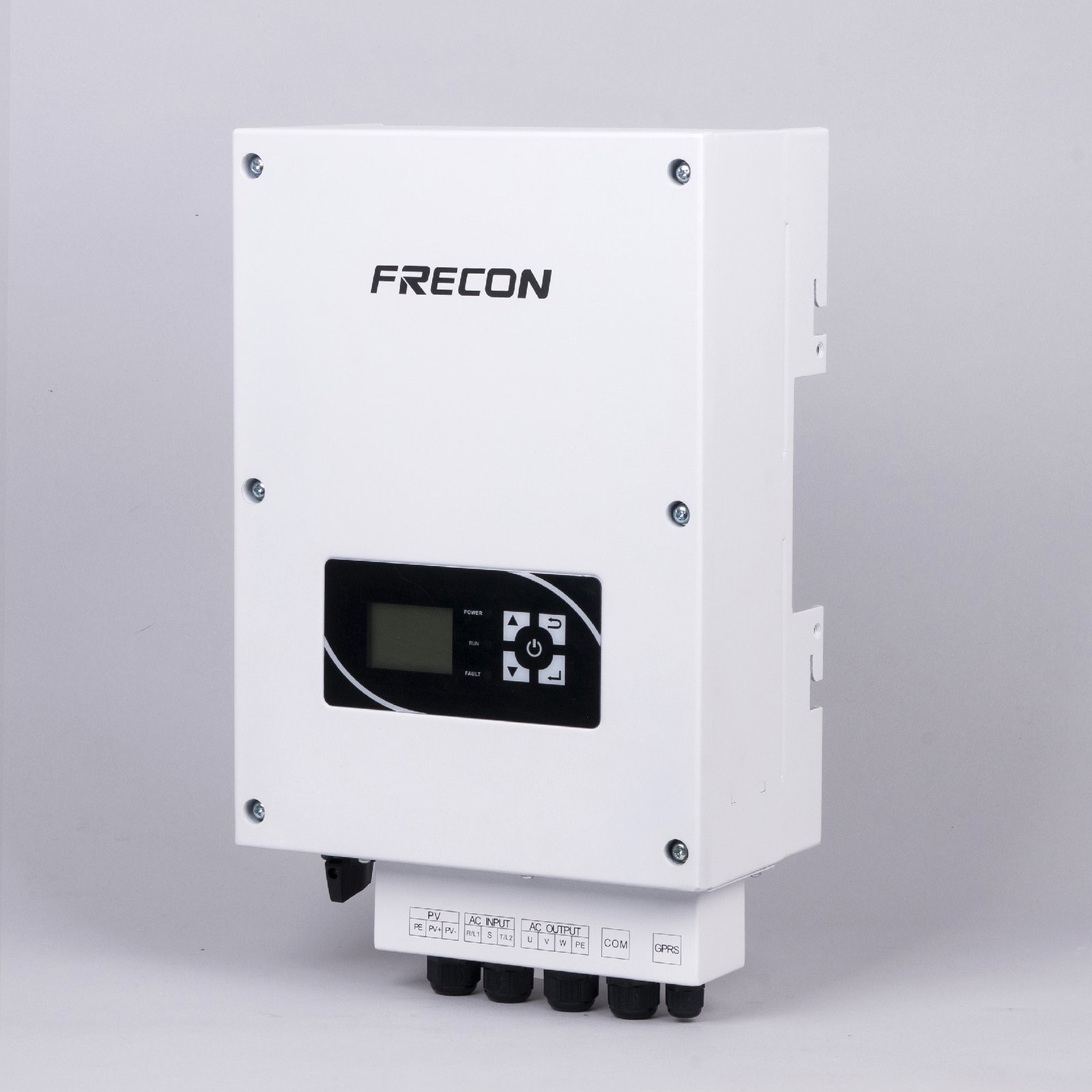
On the solar side of the comparison stands FRECON‘s PV600. Each function in that list is built into it: sleep and wake-up driven by sunlight intensity, protection against dry running, control of tank water level, and an accumulated record of energy generated, water flow and operating time, all without a battery and with MPPT tracking efficiency reaching 99%. Those records make it possible to compare water delivered with energy available from month to month, a comparison a grid drive seldom supports.
Hybrid Input and Protection
A drive becomes a hybrid VFD through its input side. Both solar DC and AC-grid input are accepted by FRECON’s PV600, and on the DC side its 6T configuration works with array voltages as high as 1140V. A standard 690V drive would accept the AC side but not a solar array at those voltages, and placing a separate DC converter in front of it would add its own losses and failure points.
Protection follows the industrial pattern, covering over-current, over-voltage, phase loss, short circuit and over-temperature, so engineers used to grid drives find the fault behaviour familiar. With familiar grid-drive protections sitting alongside the solar-specific functions, one unit can take over the whole role of a conventional drive.
When a Standard Drive Is Enough
A grid-connected pump with a dependable supply gains little from solar functions it will never use, and a conventional pump drive may then be the simpler choice. The balance shifts when the pump uses solar power, the site runs unattended, or a hybrid VFD is needed to bridge the power gaps by switching to an available alternative supply. Some sites start on the grid and add panels later, and a drive that already accepts both inputs avoids a second replacement when the array arrives.
Where the energy comes from, who watches the pump and what happens when the water runs out are site facts, and they settle the choice between the two drive types. FRECON’s PV600 answers all three within the drive itself, and as a solar water pump inverter rated up to 450 kW it spans sites from a 15 kW borehole pump to a large pumping station.


